

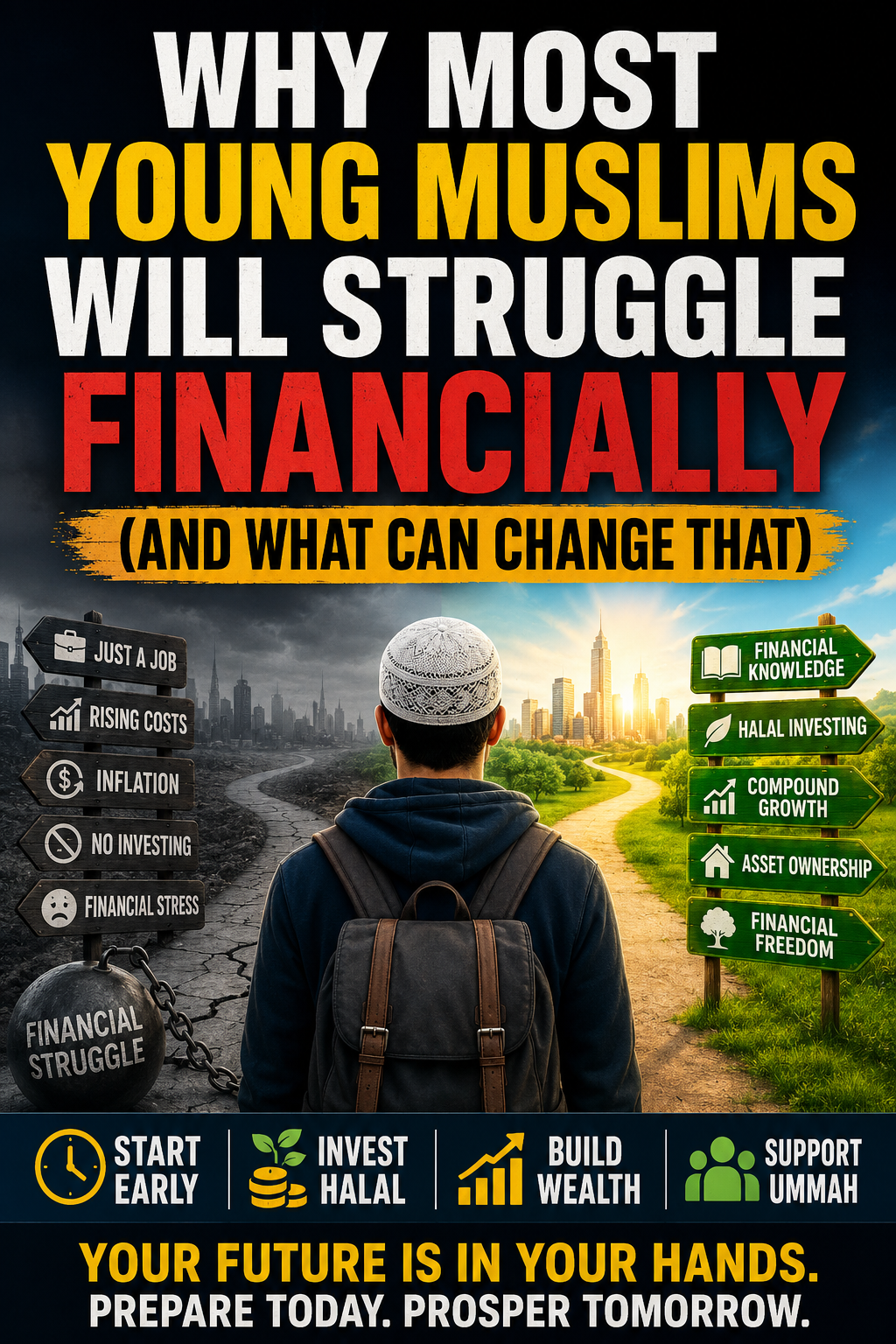
There is a reality that many young people are never taught early enough:
Financial success is not just about getting a good job.
Without the right mindset, habits, and financial education, many young Muslims will face financial challenges as adults, not because they are lazy or incapable, but because nobody showed them how money really works.
This article is not meant to create fear.
It is meant to create awareness.
Because awareness is often the first step toward building a better future.
The "Get a Good Job" Trap
Many Muslim parents teach their children a simple path:
Study hard.
Get good grades.
Find a stable job.
Earn a paycheck.
While there is nothing wrong with this advice, today's world has changed.
A good income alone does not guarantee financial security.
Why?
Because:
-
The cost of living continues to rise.
-
Housing has become increasingly expensive.
-
Inflation makes everything cost more over time.
-
Jobs are no longer guaranteed for life with the rise of Artificial Intelligence (AI).
Many people work hard for decades yet still struggle financially because they spend their lives earning money without learning how to make money work for them.
A job is important.
But it should be the beginning of a financial plan, not the entire plan.
Why Saving Money Alone Isn't Enough
Parents often encourage their children to save money, and that is a good habit.
However, saving alone is no longer enough for long-term financial success.
The challenge is inflation.
Simply put, the value of money decreases over time.
The same $100 that buys groceries today may buy significantly less in ten or fifteen years.
This means that while saving is important for emergencies and short-term goals, building wealth requires more than simply keeping money in a bank account specially because as Muslims we can't even use interest income. Remember, Riba is prohibited in Islam.
The question is no longer:
"How much money do I have?"
The better question is:
"Is my money growing over time?"
The Financial Education Gap
Young Muslims spend years learning important aspects of their faith:
-
How to pray
-
How to fast
-
How to develop good character
-
How to strengthen their relationship with Allah
These are essential parts of life.
But many young Muslims never learn:
-
How investing works
-
How inflation affects wealth
-
How businesses create value
-
How to build financial security for the future
As a result, many enter adulthood earning an income but lacking the knowledge to grow that income.
Over time, this knowledge gap can become a wealth gap.
The Fear and Confusion Around Investing
One of the biggest obstacles for many Muslim families is uncertainty about investing.
Questions naturally arise:
-
Is investing halal?
-
Is the stock market gambling?
-
What if I lose money?
-
What if I accidentally invest in something impermissible?
Because these questions are rarely discussed openly, many people choose the safest option:
They do nothing.
But doing nothing also carries risks.
Avoiding investing completely may lead to:
-
Losing purchasing power to inflation
-
Missing years of potential growth
-
Depending entirely on a paycheck for life
The solution is not reckless investing.
The solution is learning how to invest responsibly and according to Islamic principles.
Time Is a Young Person's Greatest Advantage
One of the most powerful wealth-building tools is something every teenager already has:
Time.
A young person who starts investing small amounts early often ends up in a stronger position than someone who starts much later with larger amounts.
This happens because of compounding.
Compounding allows investments to grow not only on the original amount invested, but also on the growth that has already accumulated.
The earlier someone begins, the more powerful this effect becomes.
Unfortunately, the opposite is also true.
Waiting ten or fifteen years to start can significantly reduce long-term financial growth.
Teaching Ownership Instead of Consumption
Modern society constantly encourages young people to consume.
Buy the newest phone.
Upgrade the latest device.
Follow trends.
Spend more.
Repeat.
Very few people teach young adults how to become owners.
Ownership means having assets such as:
-
Stocks
-
Businesses
-
Real estate
-
Other productive investments
Consumers spend money.
Owners build wealth.
This mindset shift can have a major impact on a person's future financial stability.
Being Financially Active Is Part of Responsible Stewardship
Some Muslims avoid investing because they are concerned about earning income in a way that displeases Allah.
That concern comes from a good place.
However, Islam does not encourage financial inactivity.
Throughout Islamic history, Muslims were traders, business owners, investors, and entrepreneurs.
Islam encourages:
-
Halal earnings
-
Ethical business practices
-
Responsible management of wealth
-
Providing for family and community
The goal is not to avoid wealth.
The goal is to pursue wealth in a halal and responsible way.
That includes:
-
Learning Islamic investing principles
-
Using halal screening methods
-
Avoiding excessive speculation
-
Giving charity and purifying wealth when required
Faith and financial growth do not have to be opposites.
They can work together.
The Biggest Risk Is Financial Ignorance
Many people think investing is the greatest financial risk.
In reality, there are other risks that receive far less attention:
-
Not understanding how money works
-
Not planning for the future
-
Depending entirely on one source of income
-
Never learning basic financial skills
The greatest danger for many young Muslims is not the stock market.
It is entering adulthood without financial literacy.
A Different Future Is Possible
The good news is that this story can change.
Young Muslims do not lack intelligence, ambition, or potential.
What they often lack is:
-
Exposure to financial education
-
Guidance from knowledgeable mentors
-
Confidence in understanding financial systems
-
A clear roadmap for building wealth Islamically
With the right education and mindset, young Muslims can:
-
Invest in a halal manner
-
Build long-term wealth
-
Support their families
-
Strengthen their communities
-
Reduce financial stress later in life
The earlier these lessons are learned, the better.
Not because life becomes easier, but because preparation begins sooner.
And just as we teach our children to prepare for their akhirah, we should also teach them to prepare responsibly for their financial future.
Time is one of Allah's greatest blessings.
The young person who learns to use it wisely today may enjoy opportunities tomorrow that others spend years trying to catch up to.